
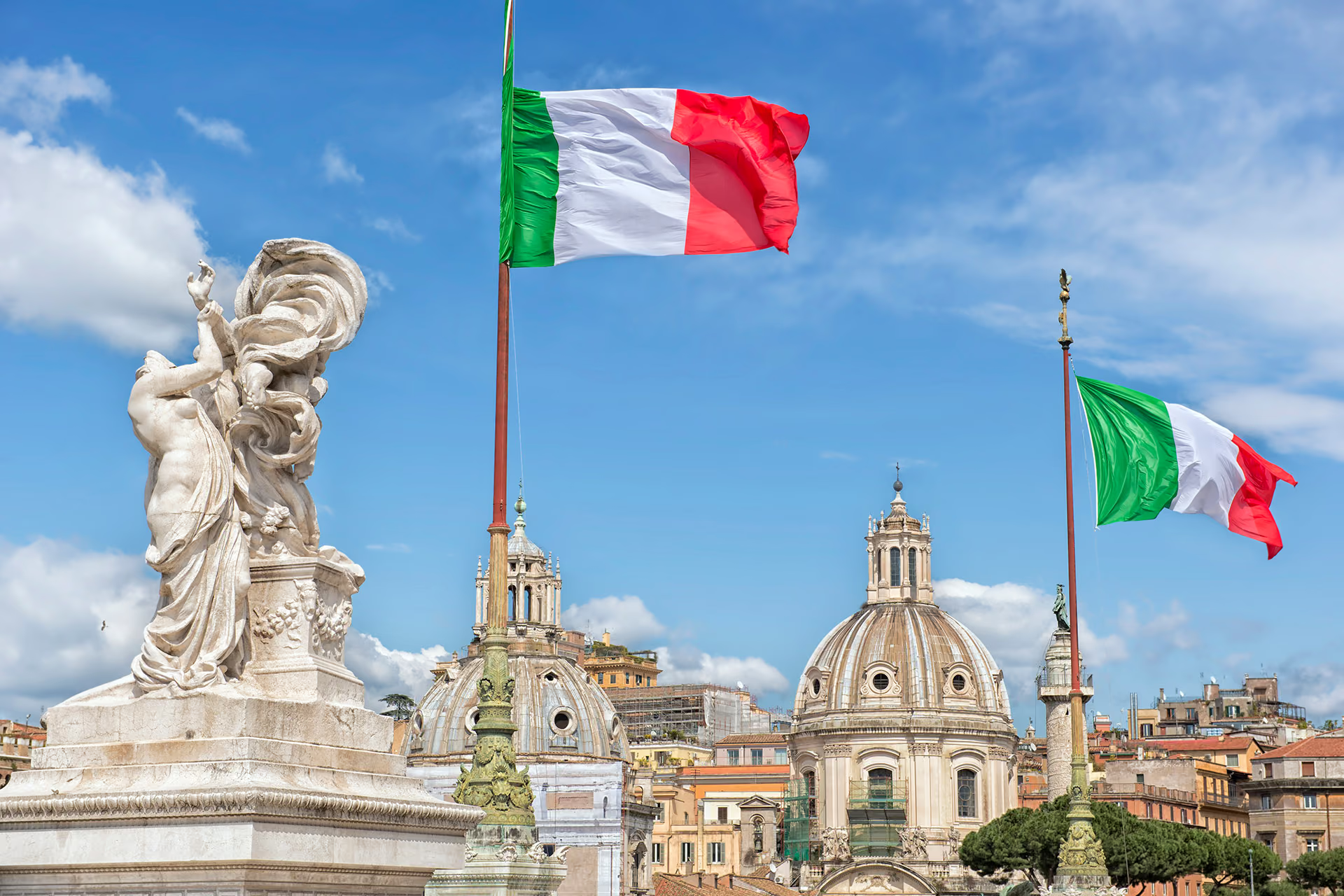
Italy continues to maintain its status as one of the most desirable destinations for relocation. In 2026, interest in life on the Apennines has acquired a pragmatic character: the country is actively modernising its migration legislation, attracting foreign specialists, investors, and digital nomads. We have analysed all current methods of legalization, regional climatic features, and economic prospects for expats.
For many foreigners, Italy is becoming not merely a holiday destination, but a viable alternative for living—with high-quality produce, cultural richness, and a relatively low cost of living compared to Northern Europe. The south of the country and the islands are particularly popular, where one can find affordable housing and enjoy the measured rhythm of the "dolce vita".
Since 2024–2025, the government has strengthened programmes for digital nomads, investors, and entrepreneurs. Furthermore, a number of regions continue to combat depopulation by offering financial incentives for relocating to small towns.
Geography and Climate: How to Choose a Region
Italy stretches from north to south, ensuring a unique diversity of natural zones. The choice of residence depends directly on your goals: career, business, or a quiet retirement.
- North (Milan, Turin, Venice): The economic engine of the country. A temperate continental climate with cool winters and humid, hot summers. Ideal for career and business.
- Centre (Rome, Florence, Tuscany): The cultural heart. Mild winters and sunny summers. A balance between business activity and tourism.
- South and Islands (Naples, Sicily, Sardinia): A Mediterranean climate with hot summers and warm winters. Here, the cost of living is lower, but the labour market is less active.
Italy faces serious demographic challenges. In 2026, the need for foreign specialists is estimated at hundreds of thousands of people annually. Foreign workers already account for about 9% of the country's GDP, and this share is growing.
Methods of Legalization in 2026
Italy offers a wide range of visa programmes. Let us examine the most reliable and current routes for obtaining a residence permit (*Permesso di soggiorno*).
1. Work Visas (Decreto Flussi)
The *Decreto Flussi* quota programme remains the primary mechanism for labour migration. In 2025, the quota amounted to a record 165,000 permits, and the trend for expansion continues in 2026. Main categories:
- Non-seasonal work: Construction, logistics, tourism, mechanics, as well as the elderly care sector (*Badanti*). The residence permit is issued for 1–2 years.
- Seasonal work: Agriculture and the tourism sector (up to 9 months).
- Self-employment: Freelancers and company directors (quotas for this category are usually limited).
Important. To obtain a work visa, it is necessary to find an employer who will process the permit (*Nulla Osta*) via the Italian Ministry of Interior portal. Independent application without an offer is impossible.
2. Digital Nomad Visa
Introduced in 2024, this visa has become a hit among remote workers. It allows one to live in Italy while working for a foreign company, without being tied to *Decreto Flussi* quotas.
-
Requirements for Digital Nomad
Income: Not less than €32,400 per year (confirmed by statements and contracts).
Experience: Minimum of 6 months working remotely in the current field.
Insurance: A policy with full coverage for the entire duration of the visa.
Accommodation: Rental agreement or proof of ownership in Italy.
Clean criminal record: Certificate for the last 5 years.
3. Investor Visa
A programme for wealthy individuals wishing to obtain a residence permit via an expedited procedure outside of quotas. Investments are made only after visa approval, but funds must be confirmed in advance.
| Type of Investment | Amount | Note |
|---|---|---|
| Innovative Startup | €250,000 | Company must be in the startup registry |
| Italian Company | €500,000 | Purchase of shares or equity (Ltd, SpA) |
| Philanthropy | €1,000,000 | Contribution to culture, science, or education |
| Government Bonds | €2,000,000 | Holding the asset for a minimum of 2 years |
4. EU Blue Card
The optimal option for qualified specialists with higher education (minimum 3 years of study) or confirmed work experience in IT (from 3 years). Requires a contract with an Italian company for a period of at least 6 months and a salary not lower than the established threshold (about €27,000 – €30,000 per year depending on the region).
Blue Card holders can bring their family under a simplified procedure and obtain permanent residence in the EU faster than through other programmes. After 18 months of work in Italy, one can move to another EU country under a simplified scheme.
5. Elective Residence (Residenza Elettiva)
Residence permit for financially independent persons who wish to live in Italy on passive income (pension, rent, dividends) without working. Minimum income is from €31,160 per year per applicant (+20% for spouse).
Important. This type of residence permit strictly prohibits any labour activity in Italy. Violation of this rule leads to annulment of the status.
6. Startup Visa (Italia Startup Visa)
For entrepreneurs ready to launch an innovative business. Requires an investment in one's own project from €50,000 and approval of the business plan by a special technical committee. The programme allows for bringing the team and family.
Permanent Residence and Italian Citizenship
After 5 years of legal residence, one can request permanent residence (*Permesso di soggiorno UE per soggiornanti di lungo periodo*). To do this, one must pass an Italian language exam at level A2 and confirm income.
Citizenship is available after 10 years of continuous residence (for EU citizens — 4 years). From March 2025, updated requirements apply: applicants must prove an "effective connection" with Italy, including knowledge of culture and social integration. The language exam for citizenship is taken at level B1.
Frequently Asked Questions
-
Can one work in Italy with a Residenza Elettiva visa?
No, this type of residence permit is intended exclusively for living on passive income. Any labour activity in Italy is prohibited.
-
What tax do digital nomads pay?
Tax residents pay income tax (IRPEF) on a progressive scale. However, new residents may take advantage of a preferential regime (*Regime Impatriati*), allowing for exemption from tax on up to 50-70% of income subject to certain conditions.
-
How long does it take to obtain citizenship?
The standard period of residence before application is 10 years. The processing of the application itself can take from 2 to 4 years depending on the workload of the prefecture.
-
Is it necessary to buy housing to obtain a residence permit?
Buying real estate does not give an automatic right to a residence permit (unlike "Golden Visas" of other countries), but having housing (owned or rented) is a mandatory requirement for any type of residence.
-
Can parents be brought to Italy?
Yes, the family reunification procedure extends to parents if they have no other children in the country of origin or if they are in a dependent position due to health conditions (proof of financial support is required).
